
For more than 200 years, West Point has produced soldiers and leaders who have served our nation in and out of uniform. Women have been part of the famous Long Gray Line of graduates for the last 30. As Army officers, athletes, wives, and mothers, as leaders in business, in non-profits and even the clergy, they’ve met challenges and overcome obstacles to lead others with strength and courage. Porcelain on Steel is an insider’s tour of one of America’s most storied institutions and what it takes to succeed in the high-pressure, high-performance, high-testosterone lab that produces leaders for the Army and for the nation.
The Aesthetic of Porcelain On Steel
Donna McAleer, Author’s Description
The title of the book Porcelain on Steel: Women of West Point’s Long Gray Line is based upon the artistic works of Tara Krause, West Point Class of 1982, and her sculptures honoring fallen warrior sisters.
Porcelain is a strong, vitreous, translucent ceramic material often used in the making of fine china. Steel is a hard, strong, durable and adaptable alloy of iron and carbon, widely used as a structural material in buildings as well as plowshares and swords. As an adjective, steel is suggestive of such character qualities as hard and unflinching. The two materials — porcelain and steel — honor the beauty and underlying strength of West Point women.
Tara Krause, the Sculptor’s Words
“Women Soar: Porcelain on Steel” is a memorial to our fallen sisters. The form incorporates
the three decades of Academy Women with the symbol of the monarch butterfly, whom the Aztec people held as the souls of their fallen warriors. It has been an interesting dance in seeing how thinly delicate we could extrude and then drape the porcelain so that it would be strong enough to survive the kiln. Each maquette is uniquely hand crafted for the families of our fallen warrior sisters.
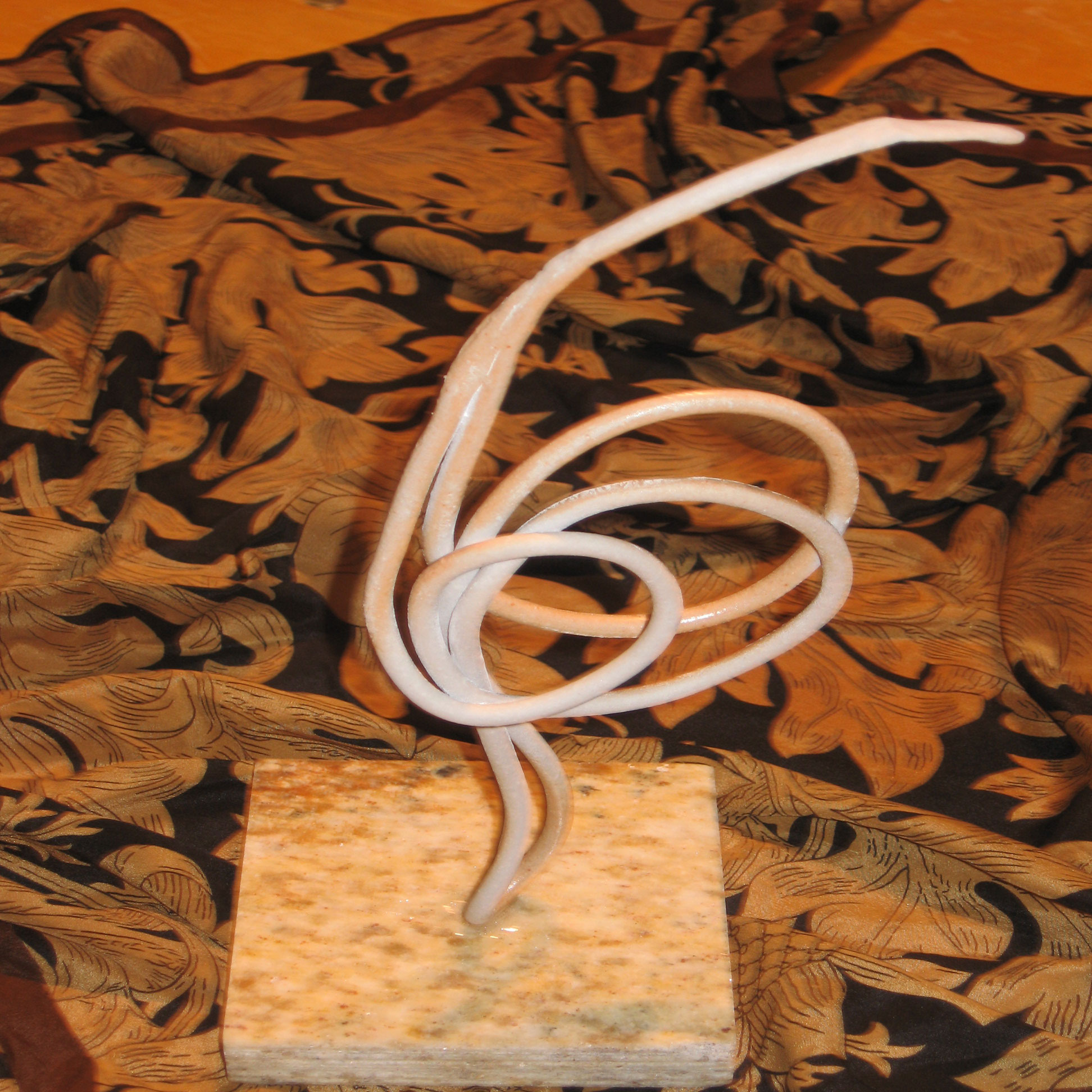
She calls it Lladro meets Brancusi.
Origin
Constantin Brancusi’s breakthrough Bird in Space sculpture was the original inspiration. Brancusi concentrated not on the physical attributes of the bird but on its movement. The bird’s wings and feathers are eliminated; the swell of the body is elongated; the head and beak are reduced to a slanted oval plane.
Subject: An abstracted bird — or perhaps the idea of “bird” or “flight” itself — reduced to a single wing shape. It reads as a perfectly streamlined form, save for one small “hurt,” or flaw: a shaved-off edge at the top. Brancusi often includes a small imperfection like this, which humanizes the piece. It is his way of deflecting from a perfect, ideal geometry — deforming the ideal with the “hurt.” Like Mondrian, Brancusi seeks the essence underlying surface phenomena, the universal rather than the particular. He distills nature down to its minimal form so the whole shape is seen at once — a reductionist, purifying process built on the belief that “less is more.” By isolating the essence, one arrives at the archetypal.
Style: Abstraction that ends in a minimalist focus on essence, expressed through a holistic shape that cannot be reduced any further. Brancusi resisted part-by-part analysis; he wanted the whole seen at once. There is a mystical fusion between the disembodied, light-reflecting surface of the highly polished bronze and the more solid, roughly carved, earthbound mass of the wood pedestal. Brancusi always treated the pedestal as part of the piece — the base functioning as the sculpture’s roots, almost literally, since many of his wood bases were hacked directly out of trees.
Context: Brancusi does away with the allegorical subject that characterized 19th-century figure sculpture, such as Rodin’s. He abstracts from nature until he arrives at the essence of the idea — the work is not mimetic, but minimalist. Like Matisse, he understood that simplicity is difficult; the archetype, the universal essence, is only reached after a lengthy distilling process. “What is real is not the exterior form,” he said, “but the idea, the essence of things.” Not everyone got the idea: when the sculpture passed through U.S. Customs, officials imposed a commercial import tax on it, refusing to see it as a sculpture at all — to them, it looked like a propeller blade.
Images of “Bird in Space” are available through the Metropolitan Museum of Art’s collection, and widely searchable online.
Tara Krause, the sculptor for Porcelain on Steel, was intrigued by Brancusi’s work — sensual and feminine, yet arguably a symbol of masculinity as well.
Process: Creating Porcelain on Steel: Women Soar
Porcelain is clay. The process begins with a sizable brick of wet clay — earthy-smelling, moist, and very heavy.
To extrude the porcelain, the clay is loaded into a wall-mounted press — something like a nine-foot-tall beer can crusher — and a huge lever is pulled down with all one’s might. (A moment that raises its own echo of West Point: a woman’s arm strength, the adrenaline of physical feats that were always tested and questioned there.) By this point, the sculptor is sweating. The porcelain extrudes like Play-Doh, emerging in long snakes, which are kneaded with the warmth of the hands into sheets. The clay turns warm and sensuous — like chamois leather. The smell of clay settles into the nose and pores; clay dust is everywhere. Then, by hand, these delicate sheets are wrapped around a piece of steel.
As the steel is wrapped, the challenge is to smooth the clay to a finish with no trace of fingerprints. A combination of tools is used, including a brush with water, to taper the ends into a flare — like the position of a woman’s arm in a ballet movement. It is a careful dance, balancing the sculptor’s hands against the goal of a smooth surface.
The feel of the piece lives in its spatial relationships. Twisting metal is one thing; rotating that metal in space, losing the original conceptual orientation, is another. In different orientations, the same form becomes a pelvis, a gun sight — many different things.
The piece then goes into the kiln for firing — the crucible of fire that produces porcelain on this earth. What was once malleable becomes brittle: perhaps a symbol of femininity itself. Without the steel, the sculpture would be lighter and more airy, but also far more prone to breakage.
The process takes about a week, and Tara makes hundreds of attempts, knowing only one or two will come out just right. She believes in auspicious coincidences and the spontaneity of working with different materials.
Mounting: How do you mount it? There was something pelvic in the final form — the center and foundation of the human skeletal system.
Symbology
- Pelvis as woman — the physiology of running alongside men, so much of the challenge women faced at West Point. How could women, by their presence alone, be perceived as a threat to such an institution of masculinity?
- Dance, sex, motherhood — the three loops representing three decades of women carried this layered symbolism, bordering on heresy in a traditionally male institution.
- Breath and the pelvis — meditation, yoga, and dance all root themselves in deep breath through the pelvis. In dissociation, that connection — that breath — is lost. Contrast this with the granite buildings and stone strength surrounding cadets at the Academy.
- Strength and openness — despite its strength, a woman’s pelvis is able to open in birth.
- The cemetery at West Point — walking it raises the consciousness of Vietnam, the marking of gravestones, the way earth opens to receive the bones of young warriors beneath an immutable slab of granite. The earth itself as a pelvis, taking back the fallen. History repeats itself in the rows of gravestones marking graduates killed in the Global War on Terror.
- The butterfly — the three loops representing three decades of women gradually took the shape of a butterfly, which led to research into the life cycle of the monarch.
- Rendering porcelain graphically — considered, among other approaches, as an etching.
- “Fallen sisters” — a deliberate play on words: fallen on the field of war and battle, but also fallen reputations, careers, marriages.
- Living up to expectations — do we live up to others’ expectations and representations of womanhood?
- Trajectory — flight carries the idea of trajectory. We launch believing the sky is the limit; on a catamaran, hiked at just the right angle, you reach the perfect speed — but a slight miscalculation in that angle can cause a crash.
- Crashing and enduring — as women, we can crash. Porcelain chips, nicks, cracks, shatters — but the steel remains. That is the quintessential theme.
- Growth and reflection — the more we grow, the more we can reflect on our own intuition.
Concept Development
In Germany, everyone purchased Hummel and Lladró figurines — beautiful porcelain pieces — part of the visual culture Tara carried into her thinking about West Point.
Brancusi captured the essence of blasting into the sky — reaching and soaring with strength and velocity, while still encountering turbulence along the way. Tara found herself drawn to similar concepts in a required course in Thermo-Fluid Dynamics, even while anchoring the class in grade rank.
The underlying question: today’s Academy women carry themselves with striking physical presence and beauty, yet they are still young women trained in hand-to-hand combat. How do you wrap that soaring, quicksilver quality inside a porcelain figure?
(Tara’s own conduct grades at West Point were notoriously poor, yet she was still invited to the Poop Deck and to dinners with distinguished visitors, thanks to her language skills. When asked to justify her inclusion, the Public Affairs office would explain simply that she wouldn’t embarrass anyone at the table — she carried herself well.)
Women at West Point could not simply be “officers and gentlemen.” How could women be Edwardian adventurers and lead the cavalry at the same time? That tension is the essence of the work.
The sculpture speaks to Academy women across every service tradition — Army, Air Force, Navy, Marines, and Coast Guard — and to women across every profession who have been killed in action: pilots, engineers, builders, and beyond.
The Air Force Academy is rich with sculpture capturing the essence of flight and soaring. Military academies, more broadly, are no strangers to sculpture read as phallic symbol — raising the question of whether the Brancusi form itself could be read as both beautiful and phallic.
2006 marked three decades of women at the military academies — hence the three loops within the sculpture’s form.
Flight, and the act of flying, run through the whole concept — including the helmet of Pallas Athena, which reads as strikingly sensual once removed from its martial context. Its curves, its brasswork, its silhouette are instantly recognizable — an image whose curves echo throughout the piece.
Background
Pallas Athena
The war goddess of the ancient Greeks was Athena, often called Pallas Athena, or simply Pallas. The Romans identified her with Minerva, ranking her third among their gods after Jupiter and Juno. Athena was also worshiped as the goddess of wisdom and of crafts, particularly spinning and weaving.
According to mythology, Athena was the favorite daughter of Zeus, said to have sprung from his head fully grown and clothed in armor. She is usually shown wearing a helmet and carrying a spear and shield, and — like her father — wearing the magic aegis, a goatskin breastplate fringed with snakes that produced thunderbolts when shaken. Athena stood apart from the war god Ares: she represented the intellectual and civilized side of war, functioning less as a fighter than as a wise and prudent adviser.
Athena was regarded as the protector of all cities and states, wise not only in war but in the arts of peace — credited with inventing the plow and teaching men to yoke oxen.
Athens became the principal seat of her worship. Zeus decreed the city would go to whichever god offered the people the most useful gift. Poseidon offered the horse; Athena struck the ground with her spear and caused an olive tree to spring up. The people favored the olive, and Zeus named the city for Athena, who is often depicted with an olive branch as a symbol of peace and abundance.
On the Acropolis, the Athenians built the Parthenon in her honor, home to the great ivory-and-gold statue Athena Parthenos by Phidias, the most celebrated of Greek sculptors. Their most important festival, the Panathenaea, was celebrated on her mythical birthday with a great procession.
The U.S. Military Academy Coat of Arms and Motto
“Duty, Honor, Country” — West Point’s time-honored motto — is embedded in the Academy’s coat of arms, both younger than the institution itself but rich with history of their own. 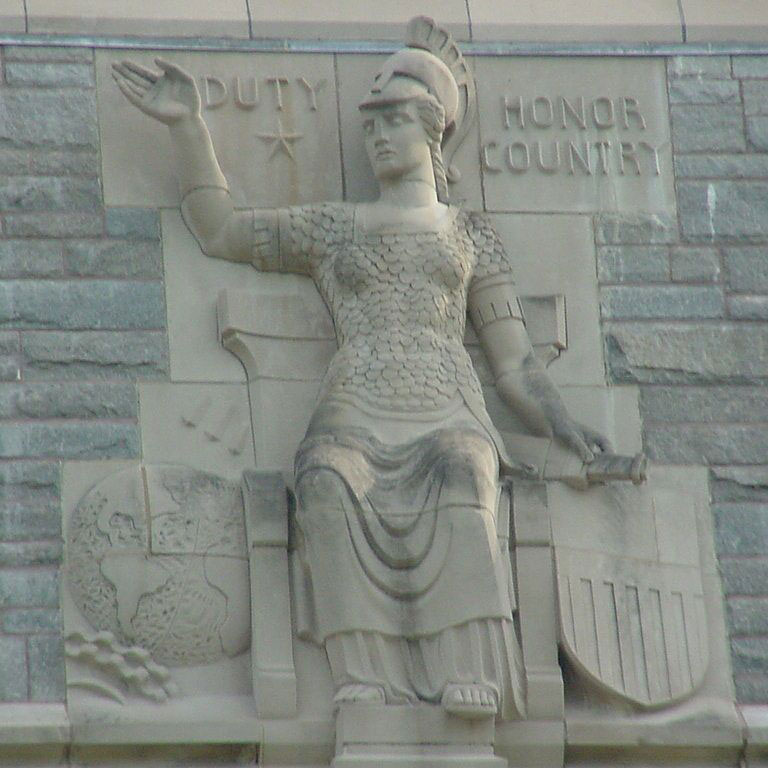
According to archival records, the coat of arms and motto were formally adopted in 1898. Col. Charles W. Larned, professor of drawing, led the committee tasked with the design, setting out that it should represent the Academy’s national character, its military function, its educational mission, and its underlying spirit and objectives.
The committee built the emblem around a sword — a universal symbol of war — paired with the helmet of Pallas Athena. Athena, a fully armed mythological goddess associated with the arts of war, carries a helmet that signifies wisdom and learning. The emblem is set on a shield bearing the arms of the United States, crested by a bald eagle, the national symbol. The eagle’s claws hold thirteen arrows, representing the original states, alongside oak and olive branches — traditional symbols of peace.
The eagle grasps a scroll bearing the words “West Point, MDCCCII (1802), USMA,” and the motto “Duty, Honor, Country.” The motto itself was never formally proposed as such, but the recurrence of those three words throughout the writings of early superintendents, professors, and graduates made the choice feel inevitable. The committee offered no ranking of the three ideals — though, as Maj. Gen. Bryant Moore observed in a 1951 issue of Assembly magazine, there may be significance in “Honor” standing at the center, forming the keystone of the arch on which West Point’s founding ideals rest.
The coat of arms went unchanged until 1923, when Capt. George Chandler of the War Department pointed out to Superintendent Brig. Gen. Fred Sladen that the eagle and helmet faced the heraldic sinister side. The helmet, eagle’s head, and sword were soon repositioned to face the correct direction. Since 1923, the coat of arms has remained in continuous use at West Point, carved into many of its older buildings, and in 1980 was formally registered with the Library of Congress as an identifiable logo of the Academy.